 lines
lines
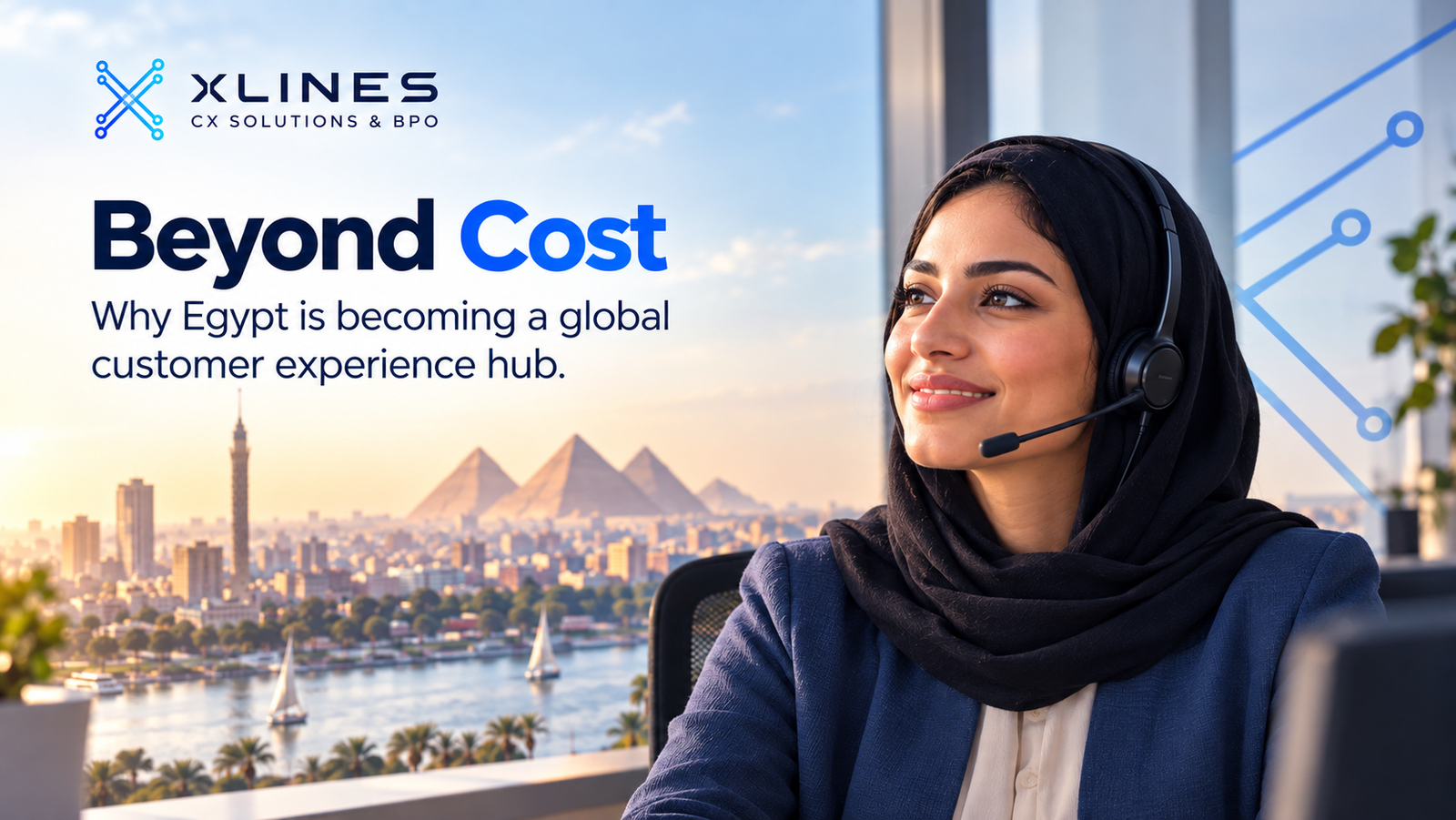
Beyond Cost: Why Egypt Is Emerging as a Global Customer Experience Hub
For years, outsourcing decisions often came down to one question:
How much can we save?
Companies compared labor costs, workforce availability, and operating expenses. If a location could deliver the required service for less, it was usually worth considering.
And, of course, cost still matters.
But the conversation is changing.
Today, businesses are asking bigger questions:
Can we improve the customer experience? Can we scale faster? Can we access the right talent? Can our partner support multiple markets? Can they help us understand what our customers are actually telling us?
That shift is changing the role of outsourcing.
And it is one reason Egypt is becoming increasingly relevant to global customer experience and business operations.
The Question About Egypt Has Changed
When a company considers moving a customer-facing operation to another country, the concerns are understandable.
Will customers receive the same level of service? Will the team understand our brand? Can they communicate naturally with customers from different markets? Can the operation grow without sacrificing quality?
These questions matter because customer service is one of the most visible parts of a business. For many customers, the person answering the call, replying to a message, or solving a problem is the company.
Egypt's outsourcing industry has spent years building experience around these challenges. As the market has matured, the conversation has started to change.
The question is no longer simply: "How much can we save by operating from Egypt?"
It is increasingly: "What can we achieve because our operation is in Egypt?"
That is a much more strategic question.
Why Egypt?
Egypt has developed into a significant destination for global offshoring and business services.
According to ITIDA, Egypt's offshoring exports reached USD 4.8 billion in 2025. The country now hosts 240+ offshoring companies operating 270+ delivery centers that serve clients in more than 100 countries.
But the numbers only tell part of the story.
Egypt's outsourcing ecosystem now extends beyond traditional contact centers into business process services, IT, knowledge services, engineering and R&D, finance, HR, analytics, and AI-enabled operations.
That evolution is important. It means companies aren't simply looking at Egypt as a place to move repetitive tasks. They're increasingly looking at it as a place to build capabilities.
Talent Is More Than a Headcount
One of Egypt's biggest advantages is its talent pool.
ITIDA highlights approximately 500,000 annual graduates from more than 50 universities and 100 institutes, alongside a multilingual workforce supporting international markets.
But having access to a large workforce isn't enough.
Customer experience requires people who can learn quickly, communicate naturally, understand different customers, and adapt to different situations.
The best agents aren't simply following scripts. They're learning the product. They're understanding the customer. They're recognizing patterns. And they're taking ownership of the interaction.
That's becoming increasingly important because modern customer service isn't just about answering a customer's question. It's about understanding why the customer had to ask in the first place.
Every Customer Conversation Contains Information
Think about what customers tell a business every day. They tell you what's confusing. They show you where a process is broken. They reveal product problems. They expose gaps in documentation. They tell you when expectations aren't being met.
In other words, customer service can be one of the richest sources of information a company has.
A traditional BPO report might say:
"We handled 50,000 contacts this month."
That's useful. But imagine the conversation going further:
"These are the five issues driving most contacts. Here's where customers are getting stuck. These problems are creating repeat interactions. And here are the changes that could reduce future demand."
Now the operation is doing more than handling volume. It's helping the business understand itself. That's where a BPO partner can create real value.
From Vendor to Partner
There is a big difference between outsourcing work and building a partnership.
The traditional model is simple:
A more mature model looks like this:
The difference isn't just operational. It's cultural.
The strongest outsourcing relationships don't feel like two companies simply passing work back and forth. The external team understands the brand. The client understands the operation. Performance is reviewed together. Customer feedback is discussed. Recurring problems are identified.
And both sides ask:
"How do we make this better?"
Sometimes that means better training. Sometimes it's a process change. Sometimes it's improving the knowledge base. Sometimes it's introducing automation. And sometimes the biggest improvement is finding a problem that is causing customers to contact the business unnecessarily.
The goal isn't simply to answer more calls. It's to create better customer journeys.
Technology Should Make Customer Service More Human
Technology is also changing what businesses can expect from a BPO partner.
AI, automation, analytics, knowledge management, and better reporting can help customer experience teams work more intelligently. But technology shouldn't be introduced simply because it's available. The better question is:
"Does it improve the experience?"
Automation can handle repetitive interactions. AI can help agents find information faster. Analytics can identify patterns across thousands of conversations. Better reporting can give management a clearer picture of what's happening.
And when technology takes care of repetitive work, people can spend more time on the interactions where empathy, judgment, and problem-solving matter most.
The goal isn't to make customer service less human. It's to give people better tools to make it more human.
Egypt Is Moving Up the Value Chain
Egypt's broader outsourcing strategy reflects this evolution. ITIDA's current industry outlook highlights growing opportunities across higher-value digital and business services, including IT, business process services, knowledge services, engineering and R&D, and AI-enabled operations.
International companies are also continuing to expand their delivery capabilities in Egypt.
The bigger picture is that Egypt's role in global outsourcing is moving beyond traditional contact-center work. Businesses can increasingly use Egypt as a base for building scalable customer experience, digital, and business operations. And that changes how companies should think about outsourcing.
What Should Businesses Look For in a BPO Partner?
If cost is only one part of the equation, businesses need to look beyond the hourly rate.
Start with the customer
Can the partner represent your brand and understand the people you're serving?
Look at scalability
Can the operation grow when demand changes? Can new teams and markets launch without starting from scratch?
Look at visibility
Will you understand what's happening inside the operation, or just get a monthly volume number?
Look at improvement
Does the partner identify problems and bring ideas to the table, or stop once the agreed work is done?
And perhaps most importantly:
"Will this team behave like an extension of our business?"
Because the right BPO relationship shouldn't simply remove work from your internal team's workload. It should make the overall operation stronger.
The Real Opportunity
Outsourcing doesn't automatically create value. A cheaper operation that delivers a poor customer experience can quickly become expensive in other ways: more escalations, repeat contacts, customer dissatisfaction, management overhead, and additional quality and training costs.
The real opportunity is different. It's about bringing together:
When those pieces work together, outsourcing can become much more than a way to reduce operating costs. It can become a way to build a better operation, a more flexible operation, a more scalable operation — and, ultimately, a better customer experience.
Building With Egypt
Egypt's growing talent pool, multilingual capabilities, delivery infrastructure, and expanding digital-services ecosystem are creating new opportunities for international businesses.
But the most interesting part isn't simply where Egypt's outsourcing industry is today. It's where it can go next.
The future of BPO isn't about answering more calls just for the sake of answering more calls. It's about understanding customers better. It's about identifying problems earlier. It's about using technology intelligently. It's about building flexible operations. And it's about creating partnerships where both sides are invested in the outcome.
For companies considering their next stage of customer experience growth, the question should go beyond:
"Why outsource to Egypt?"
The better question is:
"What could we build with Egypt?"
At Xlines, that's the opportunity we see in modern outsourcing: not simply taking work off a client's hands, but becoming part of the operation, understanding the customer, using data and technology intelligently, and continuously looking for ways to make the business better.
The next step isn't simply outsourcing to Egypt.
It's building with Egypt.
Ready to build your customer experience operation in Egypt?
If you're looking to expand, scale, or transform your customer experience operation, Xlines can help you explore what the right outsourcing model could look like for your business.
Follow Xlines on LinkedIn
Get more insights like this one on outsourcing, CX, and building with Egypt — right in your feed.